
Hand and Machine Knitting: The Differences
Hand Knitting look on a Knitting Machine?
What every hand knitter should know before buying a knitting machine.
Machine knitting is fun and extremely creative. Educate yourself of what a knitting machine can do for you. This article is focused on the differences and similarities between machine knitting and hand knitting.
Charted out, designed, tracked and maintained by Angelika
Feel free to print a copy for your personal (non public) use.
Please do not copy for use on your website, commercial or noncommercial
nor for use in any printed materials.
If in doubt, email me. I'm pretty easy to get along with.
What Every Hand Knitter Should Know Before Buying a Knitting Machine
or
Is Machine Knitting Cheating?
or
Hand and Machine Knitting: The differences and similarities.
As you can tell, as I wrote this article many kinds of titles came to mind. Over the years I have worked with hand knitters who wanted to start machine knitting to increase their speed. Sometimes it was because they had a buying market for their hand knits, sometimes it was because of pain caused by hand knitting and sometimes it was because the family was just so large they wanted to increase their output. Not thoroughly checking into the abilities of a knitting machine, they often find to their dismay that machine knitting will not produce as fast and easily all of the stitches they love to use in their designs, as they thought. But with a little know how of what the machine CAN do, and a willingness to substitute some stitches sometimes, any knitter can achieve the success they desire.
Thus the title "What Every Hand Knitter Should Know Before Buying a Knitting Machine".
The common thought is that machine knitting is cheating, or that it is easy. Just throw yarn at the knitting machine, right? But the fact is that machine knitting is much more complicated and difficult than hand knitting. When a hand knitter moves into the field of machine knitting, it is often a shock to the creative side. Machine knitting takes perseverance and a stubborn constitution not to quit.
Before you can even cast on, you have to make sure you are using a knitting machine that is appropriate to the size of the yarn you are working with. Even with the appropriate yarn size, you still need to learn the rules of the knitting machine. Like driving a car, there is so much going on that you have to watch out for. After you are comfortable with your yarn and knitting machine, you need to have a large swatch done and have the stitches and rows per inch figured. A complete knit plan (schematics or pattern) needs to be preplanned.
A knitting machine is like NO OTHER piece of equipment you have ever used. It can behave in some of the oddest ways, and our logical minds have no experience to draw upon. When the yarn gets caught up around the wheels, when stitches fall off the needles, when the carriage jams or is so hard to move you need to hook it to the tow truck, do you know where to begin to look for the problem? In the beginning of this learning curve, you will be in situations where you are learning, and you are learning a lot. Machine knitting is a totally different way of producing knitwear.
Give yourself weeks, even months, to learn machine knitting techniques. And don't ever tell anyone machine knitting is cheating.
When you have mastered machine knitting, I bow down to your dedication and perseverance. You deserve it!
Thus the title "Is Machine Knitting Cheating"
and finally
Hand and Machine Knitting: The differences and similarities.
Not all hand knit stitches and techniques can be reproduce identically on the knitting machine. Some are not possible and some are tedious. Below I have addressed some of the more commonly asked questions and misconceptions regarding adapting hand knitting to machine knitting.
DIFFERENT KNITTING MACHINES FOR DIFFERENT YARNS
The most common request I get from hand knitters is “I want a knitting machine that will knit socks, blankets and baby clothes”, or “I want a knitting machine that will knit cashmere, alpaca and merino wool.”
Would you go into a yarn shop and say “I want a knitting needle that will knit wool.”?
It isn’t the type of yarn, nor is it the type of garment that determines the needle or knitting machine you need, but instead, it is the SIZE of the yarn that determines the needle or the knitting machine required.
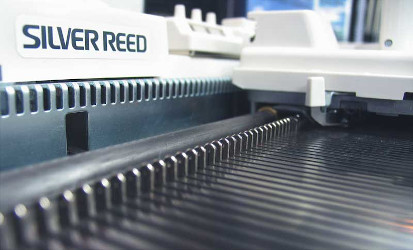
The latch hooks on a knitting machine are locked into position in slots of the bed of the knitting machine. So the stitches, no matter the size of the yarn, are locked this distance apart. This is one reason that one knitting machine cannot knit ALL sizes of yarns.
The other reason that there are different gauges of knitting machines is the size of the latch hook. On a knitting machine, it is a row of latch hooks. If you attempt to knit with a yarn that is too large, the latch hook will split through the middle of the yarn. Try to imagine crocheting a bulky yarn with a crochet hook designed for thin crochet cotton. All the hook will grab is a few hairs or strands of the yarn, just splitting it and making the next row impossible to knit.
For more detail of what knitting machine knits what yarn, read my article DIFFERENT YARNS FOR DIFFERENT KNITTING MACHINES.
STITCH GAUGE:
Matching knitting machine stitch gauge to hand knit stitch gauge isn’t too difficult. Even so it takes me 3-4 swatches on the knitting machine to achieve the exact match. Most knitting machines have a dial with number on them, usually 0-10, with 2 settings between each number. These numbers do not correspond with needle sizes. The latch hooks on a knitting machine are locked into position in slots of the bed. The stitches, no matter the size of the yarn, are locked this distance apart, until removed from the knitting machine and allowed to relax. This is one reason that one knitting machine cannot knit ALL sizes of yarns. The stitches cannot be scooted together, and you cannot measure the knitting while it is on the knitting machine. Even after the fabric is removed from the knitting machine, the stitch gauge will be distorted. Roll the fabric up and pull from top to bottom to snap the stitches, then allow to relax over night. This may seem tedious, and it is true that knitting machine knit garments take more preparation in the beginning.
If you are trying to reproduce a hand knit garment pattern, depending on the style, it may be simpler to just rechart from the hand knit schematic. Use a computer software program for knitters, select a similar style and use your stitch and row gauge that you are getting from your knitting machine. I do like the hand or feel of a hand knit gauge, so I will get as close as I can, but not worry if I am not exactly right on over 4”.
ROW GAUGE:
Many hand knit patterns instruct you to to knit until a certain number of inches have been achieved. As you knit, you are measuring. If there are fewer rows needed, this often is not apparent as you are knitting to inches/cm not rows and you are checking as you knit along. But, as previously stated our fabric cannot be measured on the knitting machine. The row gauge has to be known in advance and you have to know exactly how many rows will give you the specific number of inches. It is not until fabric is removed from knitting machine and rolled, pulled and allowed to relax that you will see what the true row gauge will measure to. It is for this reason that the row gauge must be perfectly matched to the pattern. If this is not possible, then the # of the rows the pattern calls for, must be altered so that the # of rows your knitting machine is getting will end up to the same inches/cm.
Types of knitting Machines:
Flat Bed Knitting Machine: Produces flat pieces. Most common knitting machine for hobbiests and boutique producers. Garments produced from a flat bed knitting machine normally have side seams. ; It is not possible to knit in the round on a flat bed knitting machine.
Flat beds can be manual, punch card or electronic/computer ready. This pertains to stitch designs in the pattern. Such as fairisle and texture designs. Manual knitting machines require the knitter to move the specific needles, based on a chart, into pattern position. Punch card knitting machines have punch cards of different designs that will automatically tell the carriage which needles need to do something different. For instance which needles need to catch the second color for fairisle work. Electronic/computer ready knitting machines are like the punch card knitting machines. They have electronic impulses that tell the carriage which needles need to do something different. To do pattern work on a punch card or computer ready knitting machine is very fast. On a manual knitting machine, you have to stop after every row, check the chart and pull the appropriate needles into pattern position. Not necessarily hard, but just tedious. Current manufacturers of home hobby flat bed knitting machines are Silver Reed, Artisan and Bond.
Ribber: An accessory that attaches to the flat bed knitting machine. Most common technique done with a flat bed/ribber combination is ribbing; 1x1 2x2, 3x5 etc. It is also possible to knit in the round with a ribber, but the ribber does not have the patterning abilities that the main bed does; and when the main bed is attached it cannot handle more than 1 color per row. But machine knitters have a wonderful array of stitches when there is a ribber for their knitting machine. Stitches such as tuck lace, plated rib and others are stitches that this author, as of this writing, has not seen in hand knitting. Multi-color jacquard, which can be done by hand, is commonly done by machine knitters with very thin yarn and a flat bed/ribber combination. Current manufacturers of home hobby flat bed knitting machines with ribber accessories are Silver Reed and Artisan.
PATTERN TERMINOLOGY:
There are some common terms used for both hand knitting and machine knitting; and some terms exclusive to each; and some use a different term for the same technique. To be able to translate from one to the other, you need to understand both languanges. Here are just a few common ones.
- Cast on is pretty common for both methods. In both machine and hand knitting there are numerous ways to cast on. Which technique you use depends on what the designer has decided, or what you have built up from your experience. I have found that the long tail cast on in hand knitting matches the latch tool cast on in machine knitting. And more recently I have seen a very well known hand knit teacher and designer teaching her students to latch tool cast on (or crochet hook) over hand knit needles. This same teacher is extremely knowledgeable about knitting machines.
- Cast off or bind off is quite a bit different between hand and machine knitting. Hand knitters will knit until they have 2 stitches on their right needle, then slip one over the other. Machine knitters will knit their last row, then using a latch tool, do a chain stitch-type of bind-off on the knitting machine. Actually when they are completed, they are very similar. But when you have 1 needle with 50 sts on it, the cast off technique has to be much different than when you have 50 sts on 50 hooks.
- Decreasing stitches. This has been rather fun for me over the past few years. I have decided that left and right leaning stitches on a knitting machine are ALOT easier to match than with hand knitting. I have finally found, after much research and assistance from other hand knit authors, 4 matching leaning stitches. A left and right leaning stitch on the knit side, and a left and right leaning stitch for the purl side. On a knitting machine, it is much, much simpler and easier to understand. I won't go into the details how here, as that is for another article!
- Yarn over for lace work. This was another fun challenge for me in hand knitting (can you tell I learned to machine knit first!!). On a knitting machine, you just use the transfer tool (comes with the knitting machine) and move the stitch off one needle and place onto one of its adjacent needles (which one depends on the charted design you are using). Now the adjacent needles has 2 stitches on it, and the original needle is empty. With the pass of the carriage when knitting the next row, the empty needle has yarn laid into its hook -- thus a yarn over!
- Using waste yarn is very common in machine knitting, and not so common in hand knitting. "waste yarn off" or "remove onto waste yarn" used to be called "scrap yarn". When hand knit patterns called for this technique, they used the term "Waste Yarn". Over the years, I've noticed that the term "scrap off" has been replaced in machine knit patterns by "waste yarn off". Same technique, two different terms. The technique itself is a wonderful tool and I've use it whenever the situation calls for it in my hand knitting.
STITCH TYPES:
This is one of the hardest things to explain to a knitter whose background is hand knitting. This is where using 2 knitting needles defaults to a somewhat different fabric than a bed full of latch hooks. In hand knitting, when you knit every row you get garter stitch. That is because at the end of every row, you turn the fabric before you start knitting back (circular knitting and knitting backwards is the exception). Now the fabric is reversed and you knit another row. In flat bed machine knitting the fabric is never reversed. The latch hooks pull loops away from you in every row. Therefore flat bed knitting machines default to a stockinet stitch fabric.
Stockinet
As previously stated, flat bed knitting machines default to stockinet fabric. So any design requiring stockinet fabric is easy.
Garter Stitch
Garter stitch is a reversible fabric that alternate rows of knit and purl on both sides. In hand knitting, this is done by knitting every row and turning the fabric before starting back. This is popular for new knitters as only 1 stitch, the knit stitch, is all they need to know. While this is the easiest hand knitting stitch, this stitch cannot be done simply on a flat bed knitting machine. There are a few ways to reproduce garter stitch on a knitting machine, none of them fast.
- Remove the fabric from the knitting machine onto waste yarn, turn and rehang after each row. This is extremely tedious.
- It can also be done with a garter bar tool. The garter bar hooked onto the main bed needles and the fabric is pulled onto the fingers of the garter bar. Turn the bar, (the purl side that you could see is turned around and the knit side is now facing you) and hook back onto the knitting machine needles and remove the bar. This can be quite fast.
- Brother used to make an accessory called a garter carriage. The garter carriage worked on a standard gauge knitting machine (uses yarns calling for US#0-3 needles, which are lace and fingering weight yarns). The garter carriage was automatic, it was slow and it was noisy, as it would walk across the bed either knitting or purling as per the electronics or punch card dictates.
- If there is a ribber accessory available for your flat bed knitting machine, you can transfer all the stitches to the ribber, knit 1 row and transfer back to the main bed and knit 1 row. Again, this is an extremely tedious task.
- Using the latch tool that comes with the knitting machine, drop one stitch and latch it back up. Because the latch hook is in your hand and facing the opposite direction from the latch hooks on the bed of the knitting machine, you are pulling the stitches through the opposite way. This is fine, if you have only a few stitches to reform, but tedious across a complete row.
If you are a fast hand knitter, none of the techniques above are options. If you are not a hand knitter, or a very slow hand knitter, the options above become much more feasible.
Moss / Seed Stitch
Alternating knit and purl stitches in a row is easy by hand. On the second row, the knit stitches are purled and the purl stitches are knit. Rather a checkerboard type of look if you can visualize it in a grid format. Like garter stitch, this can be done much faster by hand.
- Brother used to make an accessory called a garter carriage. The garter carriage worked on a standard gauge knitting machine (uses yarns calling for US#0-3 needles, which are lace and fingering weight yarns). The garter carriage was automatic, it was slow and it was noisy, as it would walk across the bed either knitting or purling as per the electronics or punch card dictates.
- If there is a ribber accessory available for your flat bed knitting machine, you can transfer stitches back and forth, each row (or 2 rows, as the stitch requires) between rows. This is fine, if you have only a few stitches to reform, but tedious across a complete row.
- Using the latch tool that comes with the knitting machine, drop one stitch and latch it back up. Because the latch hook is in your hand and facing the opposite direction from the latch hooks on the bed of the knitting machine, you are pulling the stitches through the opposite way. This is fine, if you have only a few stitches to reform, but tedious across a complete row.
- As a substitute, you can get a “mock” seed stitch by using a machine knit stitch called a tuck stitch. The stitch gauge isn’t the same, and there is a knit side and a purl side, so it isn’t reversible. Tuck stitch (hand knitters call it Brioche), is very fast on a knitting machine, and produces a similar high-low texture.
IN CONCLUSION (here is a wild comment and very controversial!)
If at this point you are still convinced that you want a knitting machine, and/or it is now sitting in your living room, forget everything you know about hand knitting. All of it. Why? Because I want you to learn the machine for what it can do for you. Not how can you make this machine do what you did in hand knitting. Set aside your goals and step through the manual learning all that it can offer you. AFTER you have done this, open up the flood gates of your hand knitting knowledge, and see how you can adapt the 2 together for extremely creative projects.
Make sure you have the appropriate yarn and you are set to the appropriate tension on the knitting machine, and follow the manual to *play* around with the knitting machine. Get a feel for it. Learn the importance of weights, learn what role the tension mast plays and see what happens if these are ignored. The goal here is for you to see what the knitting machine can do for you. Let it and the manual show you what it is capable of, and how fast it can knit. Over the first few weeks, I recommend knitting a couple very very plain baby outfits. If you have no babies, send them to charity. Baby outfits are small enough to not be overwhelming, yet contain all the techniques you will need to learn to come to an understanding with your knitting machine. Are these knitting machines cranky?? I'd say that each one has a personality of its own and you need to figure yours out. Give yourself a good few months at least. If you have no dealer to give you lessons, expect to have times of frustration. The internet is a good place to link up with other machine knitters, and machine knitters have had to learn to survive and assist each other through the written word. But if you don't want the frustration, buy a knitting machine from a knitting machine dealer. Bottom line, I'm being honest here! There is nothing like a good dealer to slash away at a knitting machine learning curve.
Once you are comfortable and smiling at your knitting machine (and it is smiling back!). Think about your hand knit projects. What can or can not be translated easily. If it can't be translated, what knitting machine technique can you use as a substitute. Today I knit the back of an infant vest. I used a standard gauge knitting machine with a ribber and Lorna's Laces Shepherd Sock Yarn. It has 1x1 rib and set in armholes. It took me 30 minutes and it was off the knitting machine. It was fast. Unfortunately, this knitting machine gets a bit of a tighter gauge, and once it was off the knitting machine and allowed to relax, I can see I need to knit it again at a whole tension looser, as I got less than 11" wide, when my plans were for a 12" wide back. My original design had been worked up on a Brother standard bed, but today I knit this on a Silver standard bed. But since it only took 30 minutes, I'll do it again. Once I have determined what gauge this knitting machine will knit this yarn to, I can pretty much count on it. I make notes in my notebook for future projects. Next time, this vest will take me much less time.
Ways to improve your knitting machine skills is to interact with other machine knitters. Find a local knitting machine group or club. I have ladies that drive as much as 3 hours to attend meetings. Go to a different machine knitting seminars each year. Join some email discussion groups on the internet. In other words, communicate with other machine knitters.
The purpose of this article is not to discourage you from machine knitting, but to help you to understand what machine knitting really is. Hand knitters that have achieved success with machine knitting, still continue to hand knit. I have one project, when completed, will have some parts hand knit, some machine knit and crochet trim. Machine knitting is just another creative outlet to master.
So continue on in your research on machine knitting. and Enjoy!!